
AVA-003 vs. Chlorhexidine: New Preclinical Data on Candida auris Skin Decolonization

By Ted Eveleth, Founder & CEO of AvantGuard, Inc.
Two weeks of daily chlorhexidine baths, and the patient's screening cultures still come back positive for Candida auris (now Candidozyma auris). It's a frustratingly common scenario in hospitals and nursing homes and it points to a stark reality: no protocol reliably clears C. auris from human skin.
That's the gap our team successfully closed by developing AVA-003 (a proprietary antiseptic designed to clear multidrug-resistant pathogens from skin). A new peer-reviewed study published in Antimicrobial Agents and Chemotherapy, gives us our first independent, competitive look at how AVA-003 stacks up against chlorhexidine gluconate (CHG), the antiseptic most healthcare facilities reach for today. We are thrilled by these findings, which mark the first published efficacy data pitting AVA-003 against CHG in a validated mouse model.
Key Takeaways
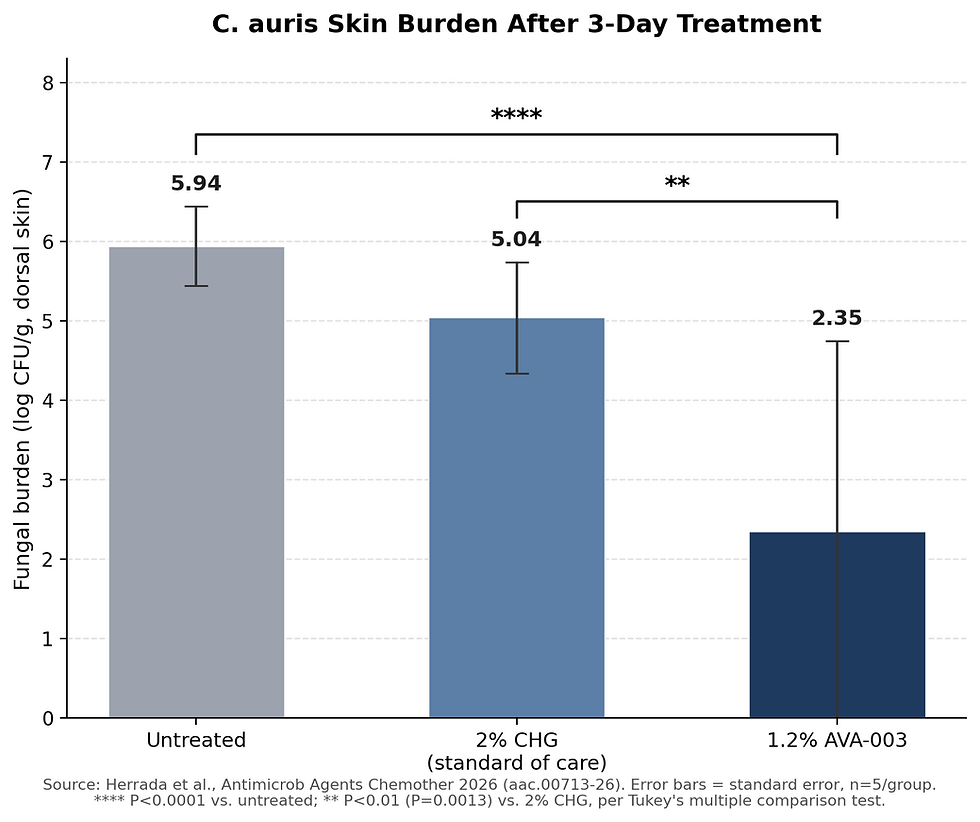
1.2% AVA-003 significantly outperformed 2% CHG at both skin sites tested after a 3-day treatment course.
AVA-003 was fungicidal against all four major C. auris clades in lab testing, at consistent concentrations across all of them.
No skin irritation was observed in any AVA-003-treated animal across either phase of the study.
The research was conducted independently by Case Western Reserve University and iFyber, LLC; AvantGuard funded the study and supplied the compound but had no role in data collection, analysis, or interpretation.
The Problem: No Proven C. auris Decolonization Protocol Exists
C. auris isn't common, but it's uniquely stubborn and dangerous. The World Health Organization classifies it as a critical priority fungal pathogen. The CDC lists it as the first fungus ever named an urgent antimicrobial resistance threat.
U.S. case counts have climbed every year since C. auris was first identified here in 2016. They nearly tripled between 2019 and 2021 alone, then continued climbing to 6,197 clinical cases by 2024, roughly 13 times the 2019 count, per the CDC's most recent surveillance data. Growth has decelerated somewhat each year since 2022 (from a 96% annual increase to 40% by 2024), though these figures likely undercount the true total. Reporting to CDC's national surveillance system is voluntary, and not every state participates. Preliminary 2025 data suggests the upward trend has continued.
For roughly 95% of colonized patients, C. auris doesn't invade tissue right away. It simply sets up residence on the skin, forming tough, multilayer biofilms on the outer skin layers. From there, it sheds readily onto bedrails and equipment, and survives routine cleaning far longer than most pathogens.
That skin reservoir carries real clinical risk. Colonized patients face a 7–20% chance of developing invasive infection, which carries a 30-day mortality rate of 30–72%.
While CHG remains the standard frontline decolonization agent in modern healthcare settings, its performance against C. auris is consistently nonsignificant. In practice, many patients remain persistently colonized despite weeks of daily baths. With cases surging nationally, this leaves healthcare facilities without an effective line of defense—driving up transmission rates, prolonging costly isolation measures, and exposing vulnerable populations to severe, life-threatening invasive infections.
Inside the Study
Researchers at Case Western Reserve University's Department of Dermatology, led by Dr. Mahmoud Ghannoum, tested AVA-003 in two stages.
Lab testing (in vitro): AVA-003 was tested against isolates from all four major C. auris clades using standardized broth microdilution methods. This builds on the clade-level lab data we shared in our MIC testing post published October 2025.
Animal testing (in vivo): Mice were colonized with a clinical C. auris isolate on ear and dorsal skin, then treated daily with AVA-003, CHG, or left untreated. A first phase identified the effective dose and formulation; a second phase compared AVA-003 directly against CHG over 3-day and 7-day courses.
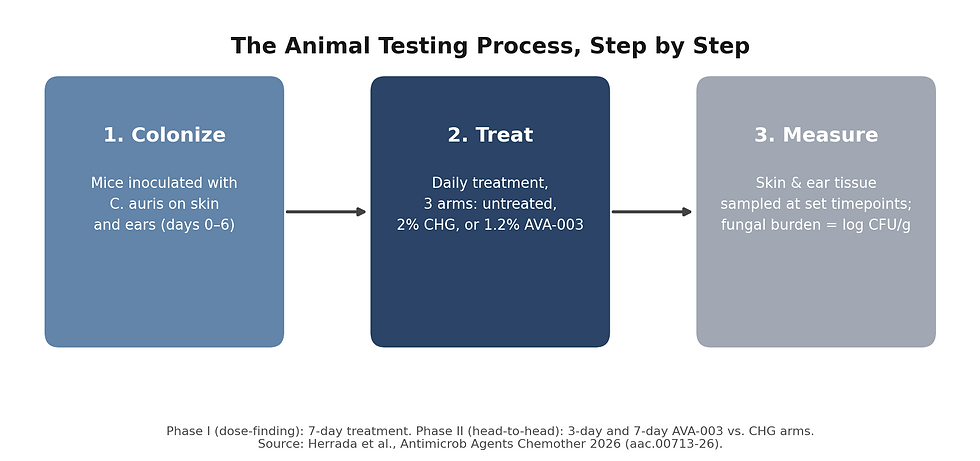
The in vitro work was conducted independently by iFyber, LLC. The animal studies were conducted independently by Case Western Reserve University. AvantGuard funded the study and supplied the compound; per the sponsored research agreement, we had no role in data collection, analysis, or interpretation.
What We Found
AVA-003 was fungicidal, meaning it kills the organism outright, not just slows its growth, against every C. auris clade tested, at consistent concentrations across all four. That consistency matters, since many antifungals perform unevenly from one clade to the next.
On skin, the advantage over CHG was clear: treated animals showed a dramatically lower fungal burden (the amount of live C. auris detected on the skin) than untreated or CHG-treated controls. In the dose-finding phase, 1.2% AVA-003 brought ear fungal burden down to undetectable levels. In the head-to-head phase, it significantly outperformed 2% CHG at both skin sites after 3 days of treatment:
No skin irritation was observed in any AVA-003-treated animal across either phase.
AVA-003's edge over CHG narrowed by day 7, most likely because the mouse cages and bedding were not decolonized and mouse fur is uniquely susceptible to colonization, enhancing pathogen growth. That's a recognized limitation of this particular animal model, not a sign the treatment lost effectiveness.
What This Means for AvantGuard, and What's Next
This study marks the first time AVA-003 was tested head-to-head against today's gold standard treatment in a peer-reviewed paper, and the results speak for themselves. In a space where there's really no standard way to clear this fungus, that's a significant milestone.
This is proof-of-concept work in a small animal model, and there is more work to be done. The next steps we're pursuing include continued preclinical development, expanded safety evaluation, and eventual clinical investigation.
The study's authors also point to two natural extensions of this work: testing AVA-003 as an intranasal formulation, since C. auris frequently colonizes the nose as well as the skin, and evaluating it against other multidrug-resistant organisms beyond C. auris.
This publication also adds independent, peer-reviewed validation to work already underway. AVA-003 is the subject of our ongoing $2M NIH Phase IIB grant to advance the technology further.
FAQs
What is Candida auris (Candidozyma auris)?
A multidrug-resistant yeast, recently reclassified as Candidozyma auris, that the WHO and CDC both consider a top-priority pathogen due to its drug resistance and its ability to persist in healthcare environments. For more information, visit our article on HAIs and the Rise of Candida auris.
Why is C. auris skin colonization a problem, not just an infection risk?
Most colonized patients carry the organism only on their skin, where it forms biofilms and sheds continuously onto surfaces and other patients. That makes skin colonization a transmission vector in hospitals and nursing homes, independent of whether the patient develops invasive disease.
How is AVA-003 different from chlorhexidine (CHG)?
CHG breaks down microbial membranes and is the main go-to for decolonization today, but its performance against C. auris can be hit-or-miss. AVA-003 works differently through a two-pronged approach: it combines slow-release oxidative chlorine to kill the fungus with a surfactant that loosens its grip on the skin. In the 3-day test, AVA-003 outperformed CHG at both skin sites.
Is AVA-003 available for clinical use?
Not quite yet. While these initial preclinical results in animal models are incredibly promising, essential human dermal safety testing and further clinical trials are still ahead before AVA-003 makes its official debut in healthcare settings.
Looking for the full study details, clade-specific laboratory results, comprehensive statistical analysis, and limitations as noted by the authors?


Comments